PENDAX
Co-Founder
Unified exchange SDK. +65% dev velocity
The Problem
Every centralized exchange (OKX, Bybit, Bitget, Mexc, Binance) exposed its own proprietary API with different authentication, order formats, WebSocket protocols, and rate limits.
Building support for a single exchange could take weeks. Supporting multiple meant maintaining entirely separate codebases with duplicated logic.
Existing libraries like CCXT offered broad coverage but lacked the low-latency performance required for algorithmic and high-frequency trading.
Only well-resourced teams could afford multi-exchange infrastructure. Smaller developers were stuck on a single platform.
The Process
Integration Audit: Mapped every API endpoint, WebSocket channel, and auth flow across OKX, Bybit, Bitget, and Mexc to identify normalization points.
Architecture Design: Built the SDK around three pillars: normalized commands that work identically across exchanges, low-latency connections with proprietary optimizations, and a free-to-use model to maximize adoption.
Developer Experience: Prioritized comprehensive TypeScript types, intuitive walkthroughs, detailed documentation, and consistent error handling across all platforms.
Production Validation: Ran continuous feedback loops with trading teams using PENDAX in production to identify edge cases and latency bottlenecks.
The Solution
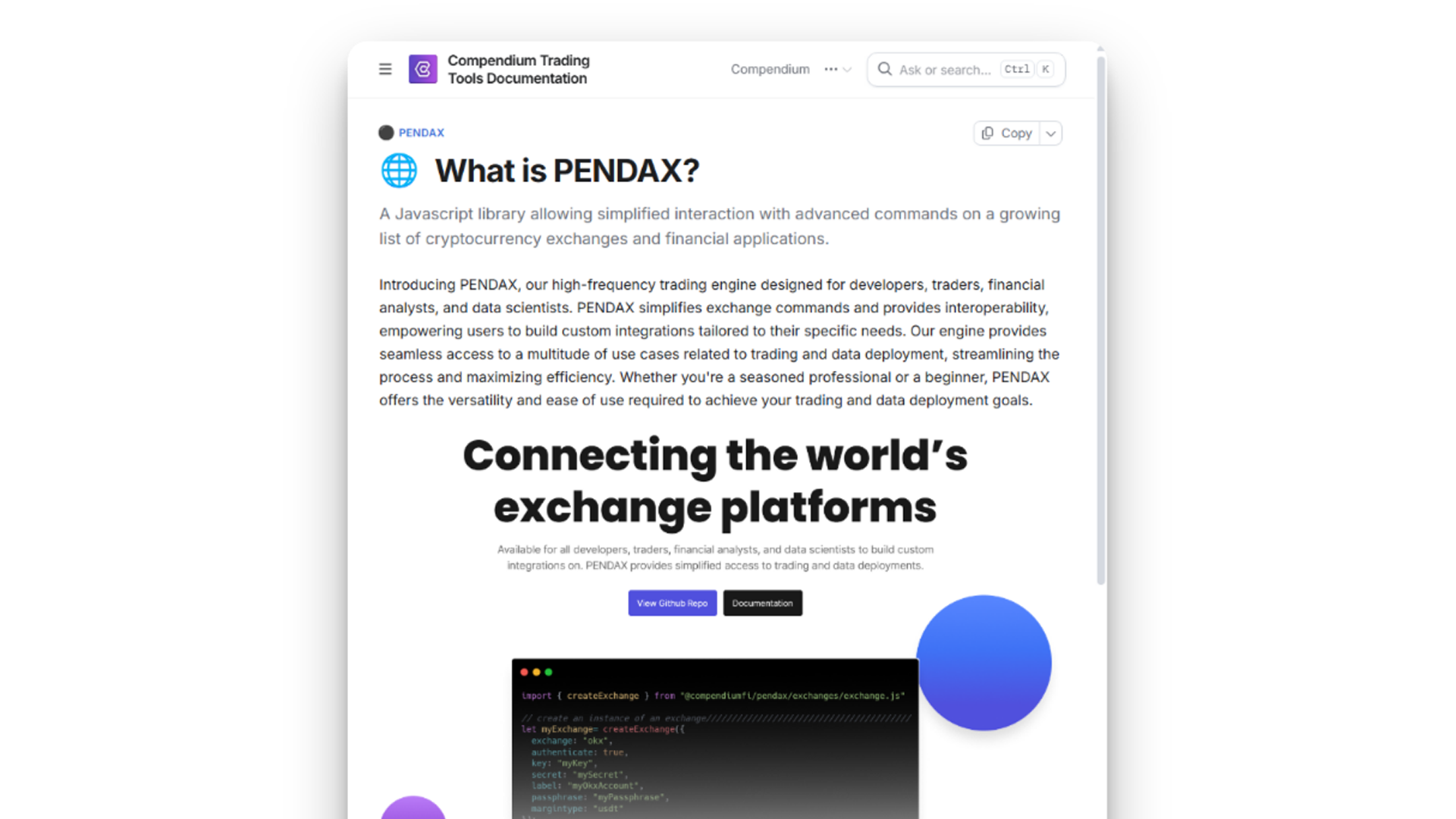
A high-frequency trading engine and JavaScript SDK providing a single, normalized API layer for multiple exchanges.
Unified REST + WebSocket access across OKX, Bybit, Bitget, and Mexc
Normalized commands: Write exchange logic once, deploy everywhere
Low-latency optimized for algorithmic trading and market-making
Free to use: No subscription tiers, integrators receive variable trading discounts
Powers Compendium.Fi's production infrastructure with load-balancing for institutional-grade performance.
Binance, Deribit, Gate, Kucoin in development.
The Outcome
Increased developer integration velocity by +65%, which compressed weeks to days
Adopted by multiple trading teams across the Compendium ecosystem
Eliminated duplicated codebases: Small teams now operate across 4+ exchanges with the effort that previously supported one
Free-to-use model drove rapid adoption and community contributions
Low-latency performance matched or exceeded direct exchange integrations in production benchmarks
Key Product Decisions
Optimized for low-latency performance over broad exchange coverage — quality of integration mattered more than quantity
Made the SDK completely free rather than tiered — adoption speed was more valuable than direct revenue
Built full WebSocket support from day one — real-time data is table stakes for serious trading infrastructure
Designed the normalization layer to be exchange-agnostic so new integrations require adapter code only, not architectural changes
What I Would Do Next
Complete Binance integration to cover the largest exchange by volume
Build a developer portal with interactive API playground and code generators
Add strategy backtesting tools so developers can validate against historical data before deploying live
Role
Co-Founder
Skills & Tools